
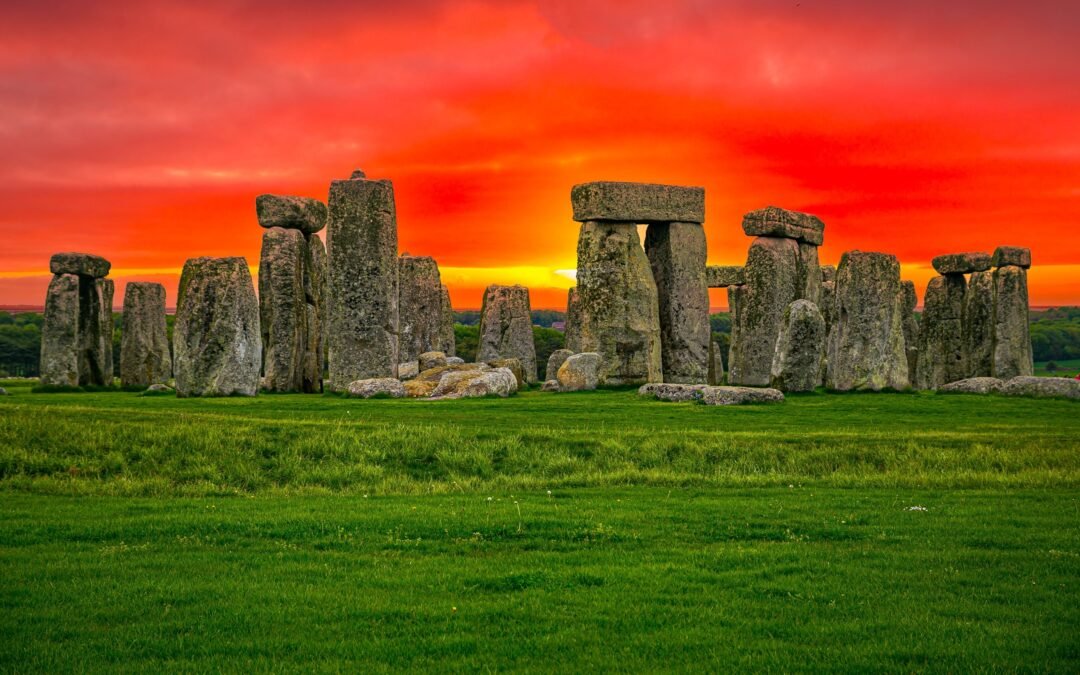
Probably the most outstanding factor about Stonehenge—the stone circle first constructed on the Salisbury Plain in Wilshire about 5,000 years in the past—is that the extra trendy scientists clear up its mysteries, the extra its fascination grows.
Due to current analysis, we’ve progressed past Stonehenge legends and lore, and it has now been established the place the stones quarried and dropped at Stonehenge originated. The sarstens have been quarried regionally, whereas many bluestones got here from Wales and the altar stone, Stonehenge’s center, came from as far away as northeast Scotland.
We additionally know the location was used for astronomical alignments like solstices and was a gathering place for individuals from around ancient Britain. Nonetheless, what’s simply been verified by way of a recent study by the University of Salford is that Stonehenge was additionally an acoustical marvel. These contained in the stone circle had their phrases and music magnified, whereas these exterior couldn’t hear a factor.

Associated
These Prehistoric Burial Mounds Look Alien From Above (& Are Just A Walk Away From Stonehenge)
The Winterbourne Stoke Burrows is a cluster of historic Stone or Bronze Age burials near Stonehenge that everybody ought to discover.
What Has Been Found About Stonehenge’s Acoustics
Stones on the historic web site affected the sounds made contained in the circle
Over the previous decade, Trevor Cox, professor of acoustical engineering, and colleagues on the College of Salford in Manchester, England, have constructed a scale mannequin of Stonehenge (one-twelfth the actual measurement) to review the acoustics of the stone monument and maybe clear up extra of its historic mysteries.
After discovering what Stonehenge regarded like at its peak configuration round 2,000 BC, Cox and colleagues created a mini-Stonehenge utilizing 3D printing. Then, they used pc modeling to study extra about its acoustical properties.
The primary outcomes of this experiment, revealed in October 2020 within the Journal of Archaeological Science, famous that the stones triggered reverberations that magnified and enhanced the sounds made contained in the circle they shaped.
Nonetheless, within the years since, they’ve realized much more by exploring how the presence of individuals contained in the circle may have modified the acoustical profile.
“We all know that individuals being inside would have modified the acoustics as a result of we take up sound,” Cox defined to BBC in 2023. “We need to quantify the way it might need modified as extra individuals went contained in the circle as a result of presumably there have been individuals contained in the circle in the course of the ceremonies.”

Associated
7 Underrated Stone Circles Even More Mysterious Than Stonehenge
From Japan to Armenia to Portugal, these stone circles could also be much less well-known than Stonehenge, however they’re no much less fascinating.
The Significance Of Latest Stonehenge Archaeoacoustic Experiments
The positioning functioned as a prehistoric echo chamber for these attending ceremonies
What Cox and his colleagues realized from placing individuals into the acoustic modeling equation is that Stonehenge had an echo chamber impact, amplifying sound to individuals attending gatherings contained in the circle by as a lot as 4 decibels. Nonetheless, sounds didn’t really echo however have been louder earlier than rapidly fading away.
This is able to have had the impact of creating occasions going down contained in the circle way more dramatic. Nonetheless, one of many different issues realized from acoustic pc modeling is that individuals exterior the circle could be unable to listen to something.
“If we take into consideration human ceremonies, they often contain some type of sound, whether or not that is music or talking or chanting. And we all know that in the event that they actually needed to be heard, individuals ought to have been contained in the circle,” Cox advised BBC.
The variations in how sound was heard counsel that Stonehenge, along with its astronomical makes use of, could have been a gathering place for rituals or initiations amongst a prehistoric elite. Thus, mixed with an earlier study revealed in British Archaeology that posited that hedges have been grown across the stone circle to make sure privateness, Cox could also be getting nearer to fixing yet one more Stonehenge thriller.
|
How a lot louder was the sound inside Stonehenge’s stone circle? |
4 decibels |
|
How lengthy did sound reverberate earlier than decaying? |
0.6 seconds to decay by 60 decibels |
|
How large was the 3D mannequin relative to the actual Stonehenge? |
One-twelfth the dimensions |

Associated
Stonehenge Mystery Solved? New Study Suggests A Theory For Why It Was Built
A brand new examine that explored the that means behind Stonehenge means that its final goal was as a solution to unite individuals throughout historic Britain.
How & When To See Stonehenge For Your self
The extra individuals which can be there, the higher your expertise of historic acoustics
The extra scientists study Stonehenge, the extra we perceive why historic peoples quarried stones from so far-off and traveled to this point to attend gatherings there. It’s an enchanting web site, which explains why, 5,000 years later, individuals nonetheless journey to the U.Okay. to expertise its magic firsthand.
Guests will discover many ancient archaeological sites to explore in and around Stonehenge among the many prehistoric landscape of Salisbury Plain. However Stonehenge itself stays the principle attraction. Ideally, you must see Stonehenge at sunset or in the course of the solstice.
The monument attracts nice crowds for the summer season and winter solstices, permitting one to think about how historic attendees would have skilled the acoustics at gatherings hundreds of years in the past.
In fact, not all historic stones exist within the monument. That’s why Cox and his colleagues in the end constructed a mannequin, and we now know a bit bit greater than we did previously about what Stonehenge was used for.

Recent Comments