
One of many world’s oldest meteor showers is ready to peak initially of this week, placing on a ravishing show of lights within the night time sky for the world to see.
Noticed for two,700 years, the Lyrids Meteor Shower, first recorded by the Chinese language in 687 B.C., has been lively since April 17 and finishes its glowing show on April 25. Nonetheless, from the late night of Monday, April 21, into the early morning hours of Tuesday, April 22, the traditional meteor bathe shall be seen to everybody across the globe, with the showers greatest seen within the Northern Hemisphere, Europe, and Australia.
Whereas the Lyrids Meteor Bathe generates roughly 6 to 10 meteors per hour earlier than its peak hours, the traditional celestial occasion is thought for its vivid and fast-shooting meteors, with an estimated 15 to twenty meteors passing every hour in the course of the darkest hours of the night time and morning, which is earlier than moonrise, and after moonset and earlier than daybreak. Though the Lyrids Meteor Bathe has been identified to generate as much as 100 meteors per hour throughout its peak.

Associated
This spring season’s Pink Moon can also be a micromoon and also will share the highlight with Spica, the brightest star within the constellation Virgo
Eyes to the Sky on Monday Night time Towards the Northeastern Horizon
For skygazers all in favour of watching the attractive Lyrids Meteor Bathe on Monday night time, one of the simplest ways to see the meteor bathe is to get as distant from metropolis lights and lightweight air pollution as you may. The darker the viewing space, the higher.
“The moon will come up within the post-midnight hours Apr 21-22, so the skies within the mid-evening to midnight hours shall be moon-free permitting for higher possibilities of seeing a meteor,” stated Shawn Dahl, with the National Oceanic and Atmospheric Administration’s (NOAA) Area Climate Prediction Middle (SWPC).
“There is no such thing as a notably greatest place within the U.S. to witness them, as anybody can see them if trying up and seeing one at simply the proper time. However, the perfect factor is at all times to be away from metropolis lights with a view to observe the fainter meteor streaks.”
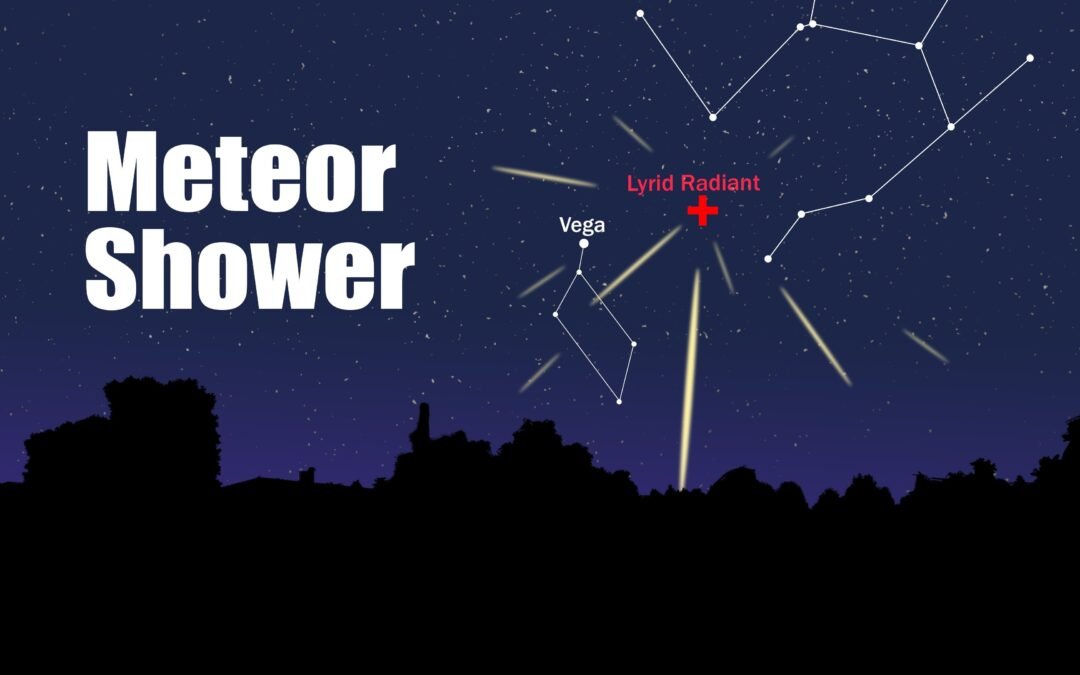
Permitting your eyes to regulate to the darkness may even aid you to see even the faintest meteor streaks capturing throughout the night time sky like a star. Give yourselves roughly half-hour earlier than the height present instances start, then set your eyes to the sky and look in the direction of the northeastern horizon, find the constellation Lyra, and the good star, Vega.
Relying on what number of meteors are streaking throughout the night time sky in the course of the peak hours, you’ll discover them simply off to the proper of the Vega star. Nonetheless, getting a full visible of the meteor bathe is greatest if viewers look away from the radiant, which is the place the Lyrids originate from.
The height hours of the meteor bathe will start after 10 p.m. native time and final till roughly 4 a.m. native time. When you can view the meteor bathe with a telescope, it is best to view it with the bare eye, whereas mendacity in your again and gazing up on the huge darkness of area.

Associated
Prime viewing places shall be in North America, Canada, Mexico, South America, Greenland, Western Europe, and Western Africa
Within the Tail of a Comet, the Lyrids Meteor Bathe is Born
The Comet Thatcher, which was found on April 5, 1861, by A.E. Thatcher, creates a path of particles particles because it travels by means of area and passes across the Earth and Solar. Inside that particles path of particles from damaged asteroids, the Lyrids Meteor Bathe was created.
Fortunately, the moon shall be at its crescent part in the course of the peak hours, permitting for higher viewing this yr of the traditional meteor bathe, in contrast to final yr’s full moon, which made the April present troublesome to identify.
“This yr, the sunshine from the crescent moon is not going to intrude an excessive amount of with the viewing,” explains Bill Cooke, head of NASA’s Meteoroid Atmosphere Workplace. “However it’s best to look away from the moon, ideally inserting it behind you,” after it rises.
April has certainly afforded stargazers and astronomers a number of treats within the celestial sky. From the Pink Moon, also referred to as the Paschal Moon, to a once-in-a-lifetime event taking place on
Friday, April 25: a triple conjunction of the moon and two planets, Venus and Saturn, which is able to type a uncommon “smiley face” within the night time sky.
Should you miss the Lyrids Meteor Bathe on Monday night, to not fear, there are extra meteor showers slated for the summer season into the top of the yr, together with the Eta Aquarids Meteor Bathe in Might, the Delta Aquarids Meteor Bathe in late July, and the well-known and epic Perseids Meteor Bathe in August.

Recent Comments