
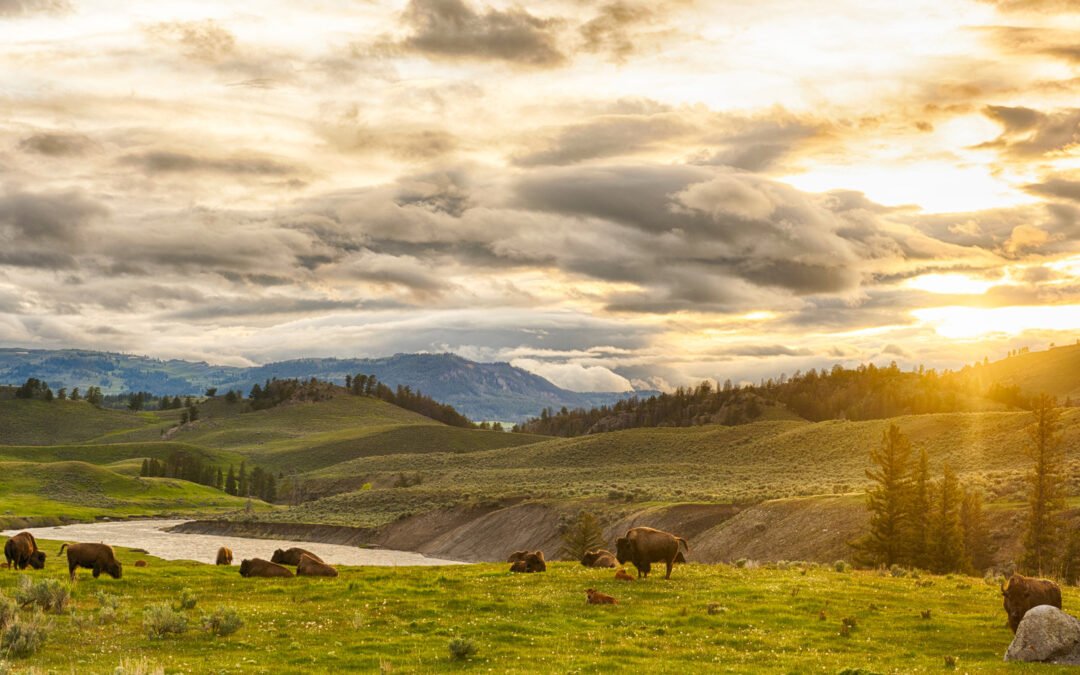
After a long time of absence in Yellowstone Nationwide Park, the pack turns into the final word savior of the park’s ecosystem. Researchers, scientists, and wildlife lovers discovered it unusual how the course modified. Wolves are identified to be on the prime of their pure meals net, and their reintroduction to Yellowstone has visibly reformatted the ecosystem.
Within the Nineteen Twenties, packs of wolves roamed freely within the park, however they turned extinct as a consequence of human actions. They have been purposely exterminated to guard livestock and large sport. Then, the prey, comparable to elk and moose, began to overgraze. Bushes and shrubs stopped rising taller or denser.
In 1995, a pack of wolves was transported from Canada to Yellowstone. From then on, the ecosystem magically modified regardless of issues amongst native livestock homeowners close to the park. However are the wolves the only engineers in Yellowstone’s ecosystem rebirth?
Wolves Shock Scientists With The Revival Of Yellowstone Nationwide Park’s Ecosystem

The final wild wolf seen in Yellowstone was within the Nineteen Twenties. The absence of wolves for a lot of a long time led to a surge in elk and moose populations. There was overgrazing. Slopes eroded, vegetation turned scarce, and degradation on the riverbanks was seen.
Then, after 70 years of extinction, america determined to reintroduce wolves into Yellowstone National Park to assist restore the steadiness to the ecosystem. It was some of the astonishing ecological tales. The land responded, as if it have been earlier than the wolves’ extinction.
Elk and moose modified their grazing habits. Beavers returned to construct dams. Rivers turned slim and stabilized, and the riverbanks have been lined once more with willows and poplars. Yellowstone also saw the return of quaking aspens that vanished almost a hundred years ago.
Based on the National Park Service, the U.S. Division of the Inside, which manages the NPS, convened an official assembly in 1972 to debate reintroducing wolves in Yellowstone. Scientists performed a research on the doable presence of wolves within the park, however biologist John Weaver later reported to the DOI that the predators aren’t there.
“The wolf area of interest seems basically vacant. Due to this fact, I like to recommend restoring this native predator by introducing wolves to Yellowstone,” reads Weaver’s report.
Two years into the restoration program, 31 wolves have been efficiently translocated to Yellowstone and fitted with radio collars to observe their actions. Officers initially concluded that the wolves would prey on livestock within the surrounding areas, however they killed solely about 10 sheep over these two years, stunning scientists.
The Astonishing Consequence

As an alternative of killing a lot of the livestock within the surrounding areas, the wolves preyed totally on elk, no less than each two to a few days. Additionally they preyed on bison and moose, which had enormous populations through the park’s wolf-free interval.
This led to a decline within the elk and moose inhabitants. As a result of the elk and moose began to note the sample, a lot of them prevented grazing in open valleys and riverbanks. This resulted in vegetation within the Higher Yellowstone Space flourishing. Their absence in lots of of those riparian areas allowed shrubs and timber to develop, together with willows, poplars, and aspens, most of that are native to Yellowstone.
Then, scientists observed that the wholesome progress of riparian zones in Yellowstone attracted beavers, which construct dams, permitting rivers to stabilize. From there, a “tropic cascade” was seen:
- Beavers created dams throughout streams.
- Dams slowed water, creating ponds or flooded areas that, in flip, deposited sand, mud, and different sediments.
- As sediments constructed up, the rivers turned firmer and extra secure, protecting erosion at bay.
- With stabilized waterways, bugs thrived in vegetation and water, attracting fish and amphibians.
- The thriving timber and shrubs alongside riverbanks shaped layered forest constructions, turning into feeding and nesting grounds that entice river-loving birds.
The wolves’ presence in Yellowstone and the behavioral shift of most of their prey have reshaped the panorama, boosting the ecosystem.
Are The Wolves The Lone Architects Of Yellowstone’s Ecosystem Restoration?
Based on the NPS, the wolves transported from Canada have been from sure areas of Jasper Nationwide Park and Williston Lake in British Columbia, as their surroundings was just like Yellowstone — “rolling and rugged terrain, dotted with meadows and forests of aspen, fir, spruce, and lodgepole pine, and supporting a big elk inhabitants.”
These wolves have been additionally free from rabies, brucellosis, and tuberculosis.
The one distinction between their ecosystems is that Yellowstone was degrading as a consequence of overgrazing, vegetation decline, and unstable waterways. This was fastened after wolves have been reintroduced to the park a long time later.
Timeline Of Wolves Restoration In Yellowstone (As Per Higher Yellowstone Coalition)
|
1972 |
Official assembly with the DOI to reintroduce wolves in Yellowstone |
|
1995 – 1996 |
The restoration program started |
|
1997 – 2007 |
Some wolves obtained killed, whereas others reproduced |
|
2008 – 2017 |
Wolves have been delisted and relisted on the Endangered Species Act in Montana, Idaho, and Wyoming |
|
Current Time |
Wolves have efficiently settled in Yellowstone, boosting its ecosystem and enjoying an important function as ecosystem engineers |
By controlling herbivores, wolves, a few of the most incredible animals in Yellowstone, opened the trail to restoring Yellowstone’s pure processes. Wolves do not have pure predators (apart from people), inserting them on the prime of the meals net.

In Yellowstone, they’re thought-about the apex predators, inflicting “trophic cascades,” a series of response in an ecosystem that happens when adjustments on the prime of the meals chain ripple downward. Their affect, although, is usually contested by critics, as they don’t seem to be the one animals roaming freely in Yellowstone.
Some consultants argue that whereas wolves engineered the rebirth of Yellowstone’s ecosystem, we additionally must thank different wildlife, together with beavers, bison, and even rivers.

Recent Comments